

Introduction
In modern power systems, maintaining voltage stability and improving the power factor are essential for efficient and reliable energy delivery. One of the most effective technologies developed for this purpose is the Static Var Generator (SVG).
SVGs play a critical role in reactive power compensation and dynamic voltage control, offering a compact and efficient alternative to conventional, bulky capacitor banks.
What is an SVG?
An SVG is a power electronic device that provides fast-acting reactive power compensation in electrical networks.
Unlike traditional capacitor banks or inductors, that offer fixed compensation, the SVG uses semiconductor-based switching devices(e.g. thyristors and IGBTs) to control and adjust reactive power according to the system’s needs.
In simpler terms, the SVG continuously monitors system voltage and injects or absorbs reactive power as needed to maintain voltage within a desired range. This makes it invaluable in
maintaining power quality under varying load conditions.
How SVGs Work
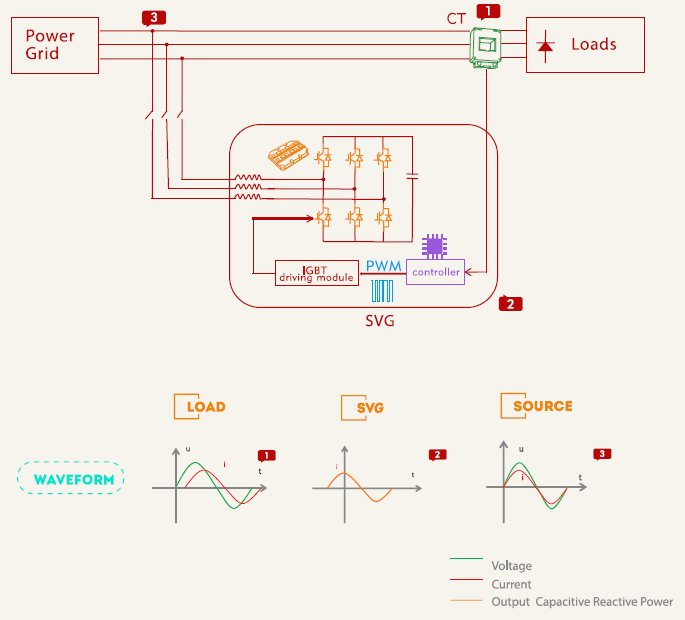
The operation of an SVG is based on controlling the firing angle of power electronic switches connected to reactors and capacitors. By adjusting the conduction period of these thyristors, the SVG can regulate how much reactive power is generated or absorbed.
An external Current Transformer (CT) detects the load current.
The control system then uses advanced logic algorithms—such as the Instantaneous Reactive Power Algorithm to:
- Separate the load current into active and reactive components.
- Calculate the reactive power variation rate quickly and accurately.
- Send PWM signals to the IGBT driver board to control switching operations at frequencies in the tens of kilohertz.
As a result, the inverter produces either inductive or capacitive compensation current.
The CT simultaneously detects the output current and provides feedback to the Digital Signal Processor (DSP), enabling more precise and stable control during the next logic cycle.
Advantages of SVG Systems
Implementing an SVG in a power system provides both technical and economic benefits:
- Improved Voltage Stability: Prevents voltage collapse during heavy load conditions.
- Enhanced Power Factor: Reduces reactive losses and increases transmission efficiency.
- Fast Dynamic Response: Adjusts reactive power in real time to maintain system balance.
- Reduced Equipment Stress: Minimizes flicker and transient voltage dips that can damage sensitive devices.
- Improved Power Quality: Mitigates harmonics and voltage fluctuations in industrial systems.
Real-World Applications
SVG systems are widely deployed across various sectors, including:
- Large Industrial Facilities: Steel plants, smelters, and manufacturing complexes.
- Transmission and Sub-Transmission Substations
- Renewable Energy Plants: Wind and solar farms to stabilize grid voltage.
- Railway Traction Systems: For reactive power support and load balancing.
These applications demonstrate how SVGs help utilities and industries achieve reliable, high-quality, and efficient power delivery.
Conclusion
As power systems become increasingly complex with renewable energy integration and variable loads, Static Var Generators continue to serve as a cornerstone technology in voltage and reactive power management. Their proven reliability, scalability, and cost-effectiveness make them essential tools for maintaining grid stability in the era of smart and sustainable energy.
At Circuit Energy, we combine deep technical expertise and extensive experience in power quality improvement to help clients design modern, resilient electrical grids.
Through strong partnerships with leading technology providers, we deliver comprehensive guidance on SVGs and other reactive power compensation systems, ensuring you select the most effective solution for your project.