
A Technical Breakdown for Commercial & Industrial Facilities
Solar PV is now a mainstream asset in Ontario’s industrial energy strategy but many facility managers still carry outdated assumptions about cost, performance, and applicability. As an EPC firm delivering megawatt-scale systems across Ontario, Circuit Energy frequently encounters these misconceptions during feasibility and due-diligence stages.
This article clarifies the most common myths with current market data, program insights, and engineering realities so decision-makers can evaluate solar based on facts, not outdated narratives.
Myth 1: Solar is too expensive for industrial facilities
Fact: Solar is now one of the lowest-cost long-term energy solutions available to Ontario’s Class A and Class B customers.
Equipment costs have declined more than 80% over the past decade, while commercial output and reliability have increased sharply. More importantly:
- Net Metering allows industrial facilities to offset high-priced grid energy one-for-one.
- Federal Clean Technology Investment Tax Credit (ITC) of 20–30%, and Save on Energy incentive of $860 per kW AC up to 1MW / $860,000, both significantly reduce capital costs.
- Solar provides decades of predictable energy costs, a strategic hedge against Ontario’s rising global adjustment and demand charges.
For Class A customers, properly sized solar PV can materially reduce peak demand exposure and stabilize long-term operating costs.
Myth 2: Solar is unreliable or inconsistent
Fact: Commercial solar provides highly predictable, model-driven generation with industry-standard availability exceeding 98%.
Ontario’s solar irradiance is remarkably stable year to year. Advanced modeling tools (like PVSyst) allow engineers to forecast annual production with ±5% accuracy.
Additional reliability drivers:
- Utility-grade modules and inverters offer 25-year+ performance warranties.
- Real-time monitoring ensures rapid detection and correction of performance issues.
- Pairing solar with Battery Energy Storage System (BESS) allows facilities to shift solar energy into evening peaks or support demand-charge mitigation strategies.
Solar is not intermittent in a commercial context it’s predictable, measurable, and engineered for long-term operational performance.
Myth 3: Solar will interfere with the facility’s structural integrity or operations
Fact: Modern commercial systems are low-profile, structurally engineered, and integrated without disrupting operations.
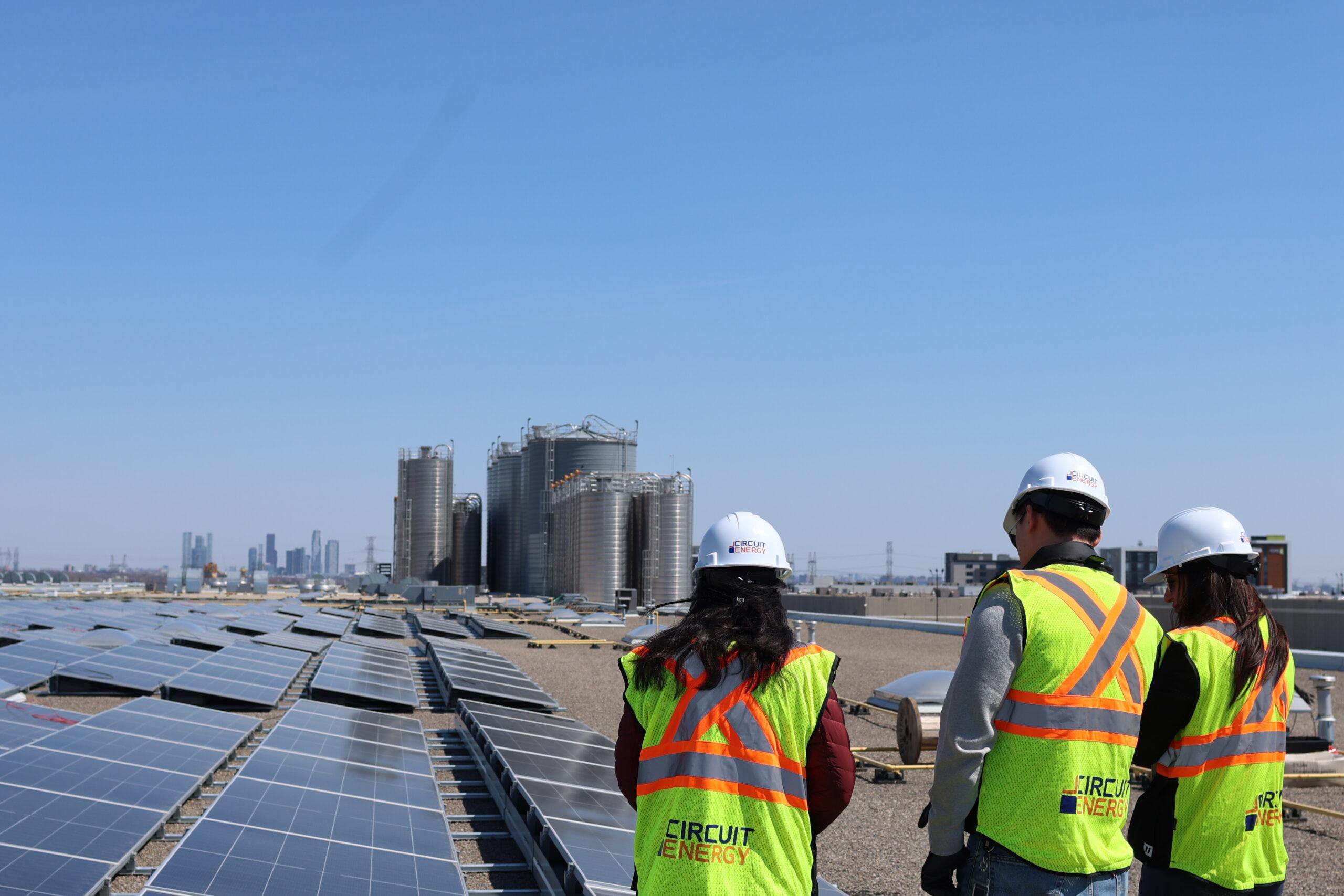
Industrial solar isn’t about appearance, it’s about engineering, performance, and reliability. Commercial systems are designed to:
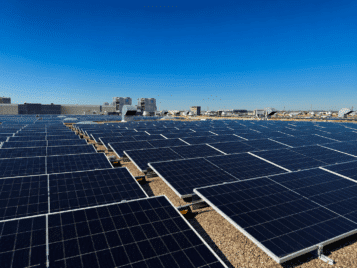
- Fit flat industrial roofs without penetrating membranes
- Maintain snow-shedding performance and drainage
- Avoid shading, vents, HVAC equipment, and production areas
- Meet CSA, ESA, and utility interconnection standards
- Preserve roof warranties through approved mounting systems
In many cases, solar improves the facility’s brand image demonstrating leadership in sustainability, ESG reporting, and energy stewardship.
Myth 4: Solar only works in sunny or warm regions
Fact: Solar performs exceptionally well in Ontario’s climate cold temperatures actually increase panel efficiency.
Solar PV operates on light, not heat. Cold, clear winters often deliver excellent production conditions. Industrial customers in northern Europe, with less sun light than Ontario, have widely deployed commercial solar for decades.
Ontario’s solar assets reliably generate power year-round, supported by detailed irradiance data and long-term performance modeling.
Myth 5: Solar can’t meaningfully impact my facility’s energy profile
Fact: Solar is fully scalable, and many facilities offset 20–60% of annual consumption, and Class A customers benefit even more.
Commercial solar is engineered based on actual consumption profiles, tariff structures, and roof availability. Even when offsetting a fraction of load, the financial impact is substantial due to:
- High daytime consumption overlap
- Significant demand-charge reductions
- Lower exposure to volatile electricity prices
- Ability to combine with BESS or power-conditioning technologies
Solar is now a strategic industrial asset not an auxiliary system.
Conclusion: Solar is a proven, cost-effective, high-reliability asset for Ontario’s industrial sector
For manufacturers facing rising electricity costs and increasing production demands, solar offers:
- Lower operating costs
- Improved energy resilience
- Long-term price stability
- Strong ROI supported by federal incentives and depreciation
- Clear ESG and sustainability benefits
Circuit Energy designs, engineers, and delivers solar PV systems specifically for industrial environments optimized for performance, compliance, safety, and long-term reliability across Ontario.
Solar isn’t the future. It’s a proven tool that leading manufacturers are deploying right now.